Thanks to everyone who attended our Dec. 7 panel, “Reporting on Health Care During Covid-19 and Beyond,” and to our smart, insightful panelists, Paul Sisson, Lauren Mapp and Jill Castellano, who shared their experiences covering everything from nursing home neglect to end-of-life care to preventable deaths. We recorded the Zoom session so those who couldn’t attend could learn some tips from our panelists.
Year: 2021
Panel Discussion: Reporting on Healthcare During Covid-19 and Beyond
Even during normal times, the healthcare beat is one of journalism’s most challenging assignments. There’s medical lingo to learn, strict privacy laws to contend with and the high-stakes task of separating truth from misinformation. Join SPJ San Diego for a panel discussion that will delve into current challenges faced by reporters covering healthcare and offer tips for navigating those challenges.
When: Tuesday, Dec. 7 from 6:30 to 7:30 p.m.
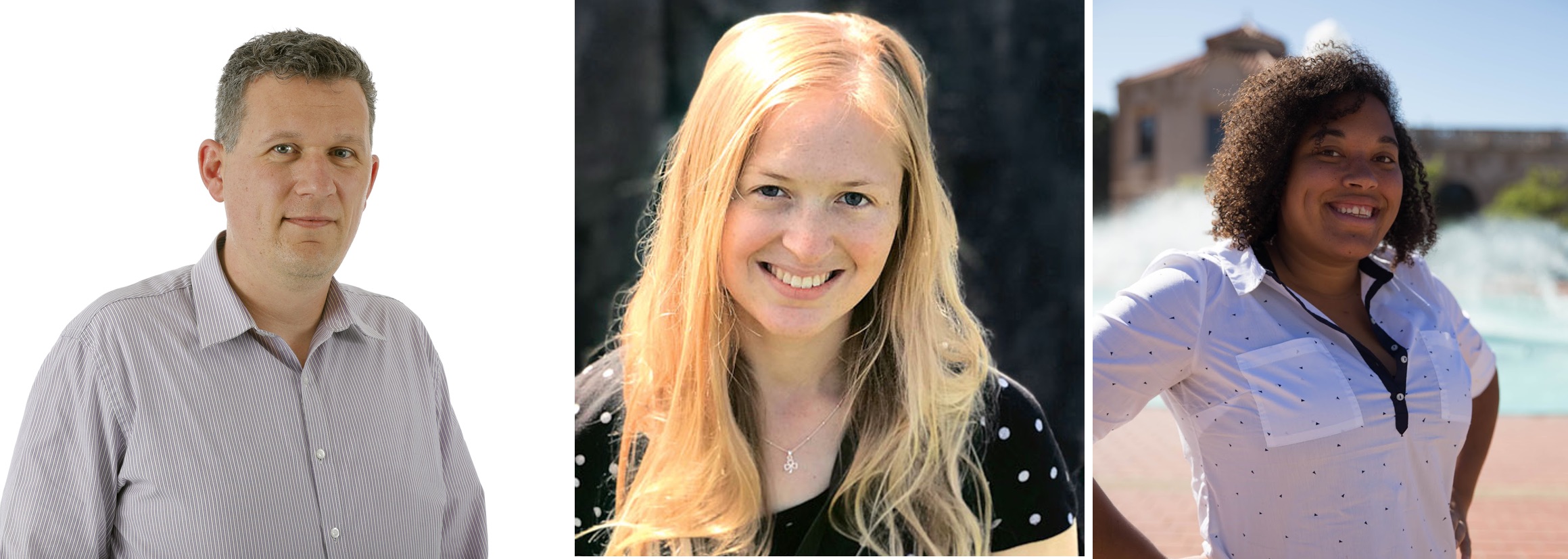
Who: Union-Tribune healthcare reporter (and our Journalist of the Year) Paul Sisson;
Jill Castellano from inewsource, whose series on COVID-19 deaths won SPJ’s 2021 Distinguished Coverage award; and Lauren Mapp, who’s been doing innovative work on the Union-Tribune’s new caregiver beat. Moderated by freelancer and SPJ San Diego president, Kelly Davis.
Where: Zoom! (While we’re looking forward to in-person events in 2022, for now we’re erring on the side of safety and accessibility.)
SD-SPJ urges autopsy report transparency
Under California public records laws, an autopsy report is often the only document available to journalists that could shed light on the circumstances surrounding a person’s death. Over the last few years, the San Diego Sheriff’s Department has made it a practice to ask the county medical examiner to seal autopsy reports of people who have died in county jails.
Last month, the Citizen’s Law Enforcement Review Board (CLERB), which investigates deaths in county law enforcement custody, asked the sheriff’s department to stop requesting that autopsy reports be sealed unless it’s absolutely necessary to protect the integrity of an investigation. As CLERB Executive Officer Paul Parker wrote in his policy recommendation, “The ‘sealing’ of a case results in the Medical Examiner’s Office not providing information to the next-of-kin and simply referring them to the [San Diego Sheriff’s Department], which limits the information it provides due to its on-going investigation. These unfortunate circumstances result in next-of-kin receiving no answers for several months, at minimum, and sometimes for a year or longer. In addition, information pertaining to in-custody deaths provided to the public is limited when a case is ‘sealed.’”
On Oct. 29, the SD-SPJ board sent a letter to Sheriff Bill Gore to express our support for CLERB’s policy recommendation and urge him to adopt it for all the reasons mentioned above. Sheriff’s spokeswoman Lt. Amber Baggs responded that in April 2021, Undersheriff Kelly Martinez verbally directed the department’s homicide unit to stop requesting that autopsy reports for in-custody deaths be sealed reports.
Baggs said the policy was in the process being finalized, and did not apply to deaths prior to Martinez’s order. The SD-SPJ board urges the sheriff’s department to make Martinez’s direction official policy as soon as possible and also ensure that autopsy reports for deaths that occurred prior to April 2021 have been unsealed. We also urge the department to be as transparent as possible when it comes to deaths that involve law enforcement personnel and seal reports only when absolutely necessary.
San Diego SPJ Releases Newsroom Diversity Survey Results
How diverse are San Diego newsrooms?
We finally have an answer to that.
The San Diego Pro Chapter of the Society of Professional Journalists is proud to share the results of our first-ever newsroom diversity survey.
See the results HERE.
Earlier this year – between February and May – we sent surveys to all local newsrooms in San Diego County seeking the breakdown of their newsroom staff members.
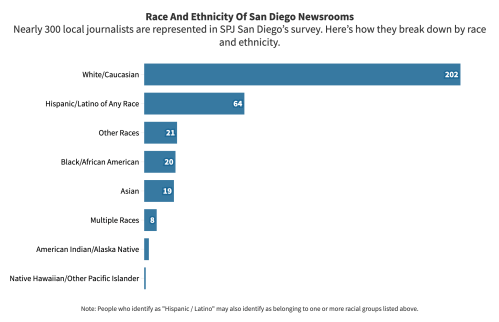
Eleven out of the 20 newsrooms responded. The results represent 288 journalists working throughout San Diego County’s media landscape. While all newsrooms were invited to participate, only one television station responded to the survey.
What did the survey show?
San Diego newsrooms are mostly white and male.
There is a large disparity between the number of Latino or Hispanic journalists employed by San Diego newsrooms — 21.9% — compared to 2019 Census estimates showing Latinos and Hispanics represent just over 34% of San Diego’s population.
Less than half of newsroom respondents employ Black journalists and only two San Diego newsrooms employ Native American journalists. Only one newsroom employs a Pacific Islander staff member.
There is much work to be done to ensure San Diego’s newsrooms reflect the diversity of the community.
Many of the newsroom respondents agreed — and shared ways they are actively working to improve the diversity of their companies.
Some have since hired additional staff who reflect their efforts to diversify their newsrooms – we encourage news organizations to share their ongoing diversity and equity efforts with us and participate in future surveys conducted by SD-SPJ.
We hope this survey is a baseline from which leaders in San Diego’s journalism community can work to improve the diversity of their newsrooms to ensure fair and accurate reporting of the communities we cover.
We appreciate the responses we received and hope we are able to get more participation in the future.
 San Diego Society of Professional Journalists